A pass is a syntax result.
It does not show that a key was honestly generated, that an implementation accepts it, or that ML-KEM has been broken. The all-zero control is an encoding example, not a generated key.
RESEARCH INSTRUMENT 001 · FIPS 203
Check the length and canonical coefficient encoding of a public encapsulation key. Start with synthetic controls, then inspect your own public-key bytes.
Use a synthetic control below or provide a public encapsulation key.
SYNTHETIC CONTROLS
PUBLIC HARDWARE OBSERVATION · IQM GARNET
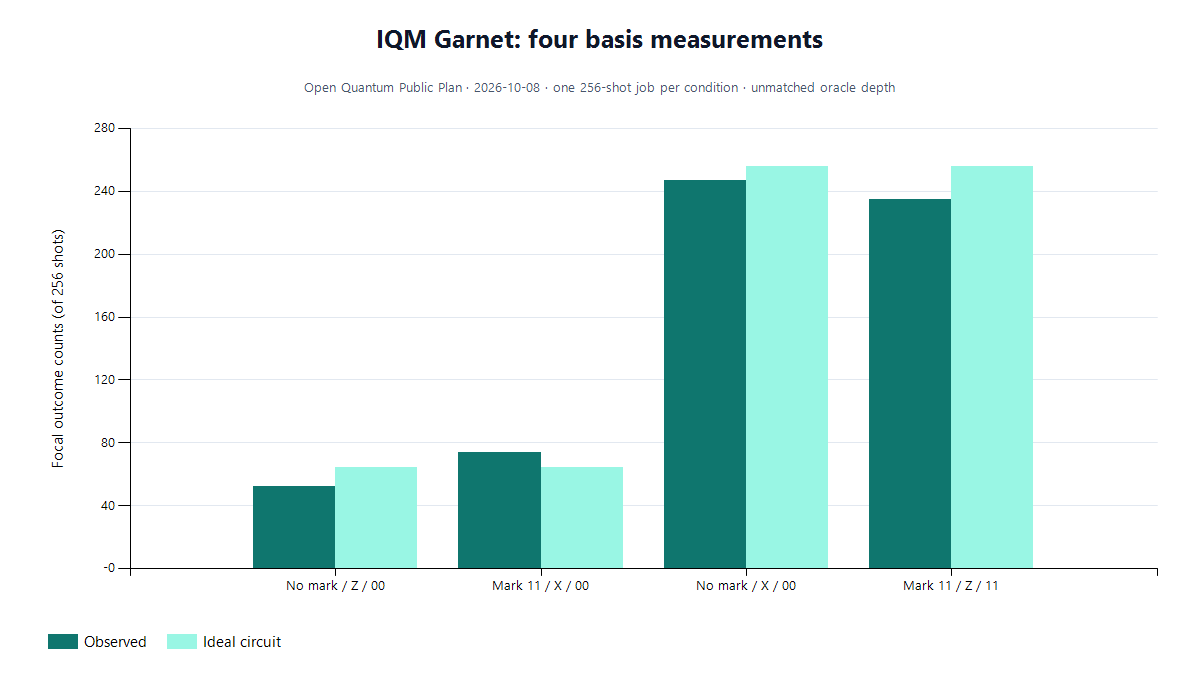
Four public synthetic circuits ran once each with 256 shots on Open Quantum's IQM Garnet. The chart compares each circuit's prespecified focal outcome with its exact ideal probability.
It does not show that a key was honestly generated, that an implementation accepts it, or that ML-KEM has been broken. The all-zero control is an encoding example, not a generated key.
The OQS test server completed one verified hybrid handshake; an X25519-only offer failed. Public test ↗ On an owner-controlled Pi, hybrid-only rejected X25519 with a server log, while a permissive configuration accepted it. Pi lab ↗ A separate pure-Go server matched all four local policy outcomes after a documented first-run closure failure. Go/OpenSSL lab ↗ These are local checks, not deployed findings or PQC breaks.
The CIC-PQC_OAV v1 CSVs support TLS migration anomaly research. They contain engineered features, not material for ML-KEM key recovery.